
Many of you have been asking about how crystallization works and how it factors into ice-cream making. . . ok, fine, no one asked about it. Just keep quiet and pretend that you did.
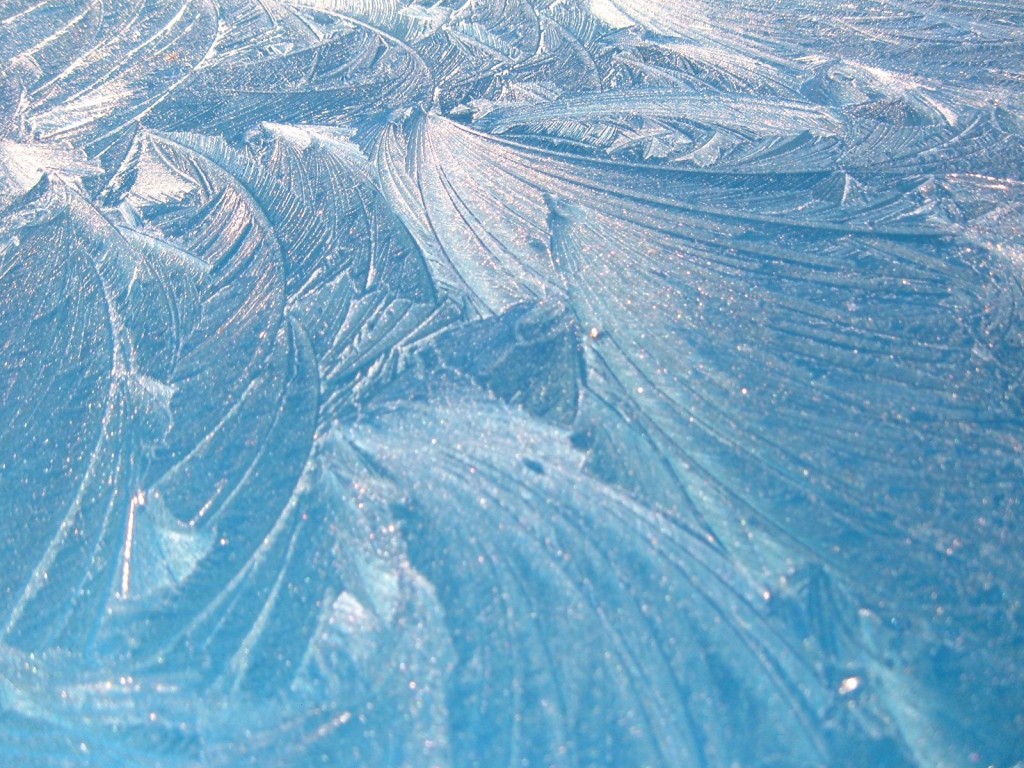
The “ice” in “ice cream” is the result of the water in the milk freezing. Crystals form when one type of molecule is given the opportunity to align with other of those same molecules: water, for instance. These molecules have a habit of bonding in a patterned way, resulting in the polyhedral structures we call “crystals.” Crystals are essential to ice-cream making, and size does matter. Large crystals are perceptibly coarse, even rough (think freezer burn), while small crystals escape our notice, and are perceived as smooth. Now, these are relative terms, but at some point, the water crystals in ice cream are small enough that we cannot feel them on an individual level, and that is when ice cream begins to feel smooth and creamy. When we aren’t ingesting them, larger crystals are the preferred crystal option, and are rarer than their smaller versions. While difficult to reproduce the conditions necessary to grow, say, large quartz crystals at home, it is a comparatively easy task to create relatively large water crystals.
As the main structural elements in ice cream, water crystals will readily form in your freezer; in fact, a freezer is primarily a “water crystalizer.” There are several conditions that must be met in order to create large crystals, and effective ice-cream making disrupts those conditions to produce small crystals and thus smooth ice cream. Because the subject molecules must be in a liquid state, or suspended therein, to crystalize, the solution’s temperature plays an important part in their crystallization. Larger crystals require more time to form than smaller ones, thus, the longer a solution can sustain temperatures slightly above freezing, the more time the molecules have time to align themselves into crystals. However, this alignment requires a certain level of molecular motion (or lack thereof) before it can take place. Very simply, this is why flowing streams and rivers do not freeze very easily—it must become very cold in order for the crystallization to overcome the kinetic force of water molecules jostling about, flowing downstream. In fact, this is the core principle at the heart of crystallization. Temperature is no more than a measure of the average kinetic energy of the water molecules, in other words, how much they are moving around. This is why crystals cannot form at higher temperatures or if physically agitated by an external force, the molecules are simply moving around too much.
Pure water freezes (and melts) at 0ºC, or 32ºF. Once you add other substances to the water, however, you impede crystallization by way of physically inhibiting the water molecules from getting close enough to crystalize. Just like with the flowing stream, this lowers the freezing point of the water, and is known as freezing-point depression. Consequently, the fat and the proteins from the half-and-half, and the sugar lower the freezing point of water, meaning that ice cream will not freeze at 0º C/32º F. To overcome this issue, something below 0º C/32º F must be used to make ice cream. Liquid nitrogen, for instance, does the trick nicely. Liquid nitrogen freezes the ice cream so quickly that the water molecules have very little time to form their crystalline structures, and thus form small crystals, which as you now know, makes for smooth ice cream. As the liquid nitrogen route is not the most practical one (liquid nitrogen is fairly inexpensive; it’s the dewar—a sort of glorified thermos used in cryogenics to maintain the contained liquid’s temperature—that breaks the bank), the older, churning method will suffice. Home ice-cream makers work in this way, churning as they freeze to in order to limit the water’s opportunity to form large crystals. Other, more radical approaches might include highly-pressurized extrusion through a tapered nozzle, defenestration, and/or a rhino (the initial being how snow guns work, and is theoretically possible, while the last two are just the first words that came into our heads (don’t judge us))*.
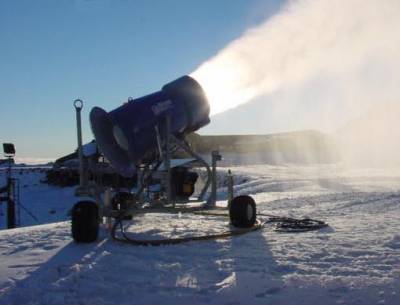
*Ah, yes, a word on nested parenthesis: they happen here—sorry.
 Erubite